Input
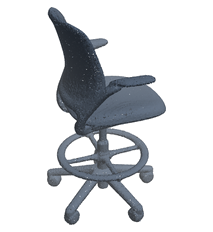
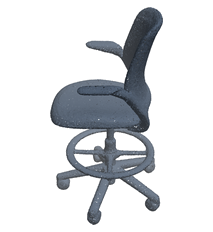
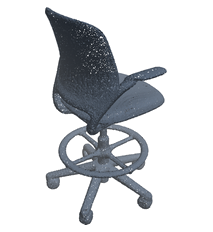
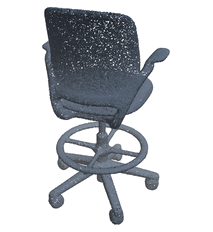
4 images + camera views
PhysDec
An agentic framework for physically grounded shape decomposition from images.
From images to simulation
Compared with geometry-focused methods, PhysDec produces physically plausible decompositions whose parts remain connected and stable in simulation.
01 / Abstract
Shape decomposition represents 3D objects as a compact set of geometric primitives for interpretable modeling and simulation. However, existing decomposition methods are trained primarily for geometric fidelity, without explicit constraints on physical plausibility, and can therefore produce disconnected parts or physically unstable reconstructions. We present PhysDec, an agentic framework that draws on a pretrained vision-language model's semantic understanding and commonsense reasoning to predict material-aware primitive decompositions from a few images. Within this framework, PhysDec-Loop is an agentic pipeline that reasons about part structure and materials, using a reference 3D point cloud for geometric feedback and physical verifiers to guide iterative correction. Through self-evolution, we further develop another agentic pipeline, PhysDec-Evolved, which learns from prior corrections to predict primitive decompositions from images without point-cloud feedback or a correction loop at inference. Experiments show that PhysDec-Loop improves geometric fidelity, physical plausibility and visual quality over geometry-focused baselines, while PhysDec-Evolved approaches its performance at substantially lower inference cost.
02 / Method
Given one to four images, PhysDec predicts a compact set of primitives, each with geometry, pose and material attributes.
Decompose
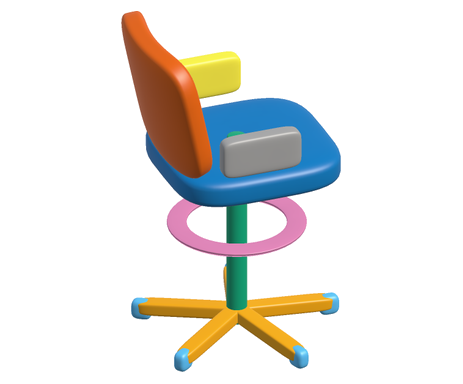
Our primitive vocabulary includes superellipsoids, toroids and hyperboloids, with tapering, bending, swept tubes and radial arrays.
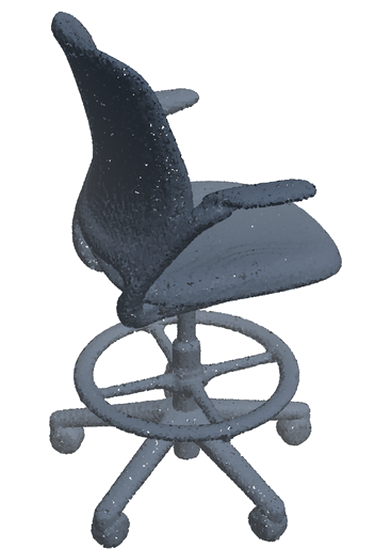
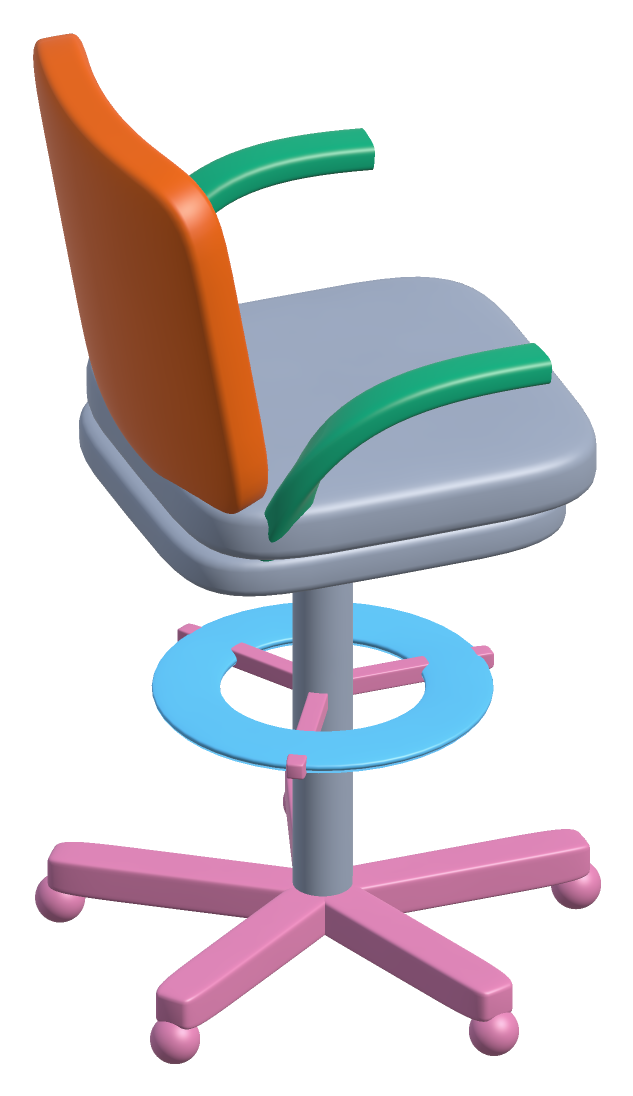
An office-chair decomposition, colored by primitive type.
The VLM assigns each part a material and construction form: solid, tube or shell. The resulting effective density and primitive volume determine its simulation mass.
Effective density (kg/m³), listed as solid / tube / shell. A dash marks an unavailable form.
 metal7800/1200/200
 wood650/–/120
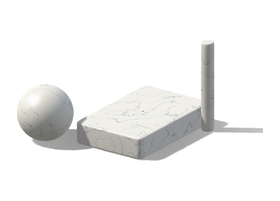 stone2600/–/–
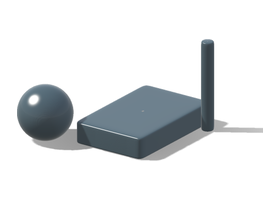 glass2500/–/300
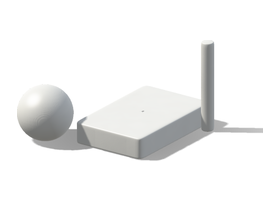 plastic1100/–/150
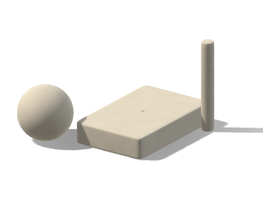 fabric–/–/20
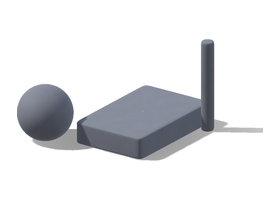 upholstery60/–/–
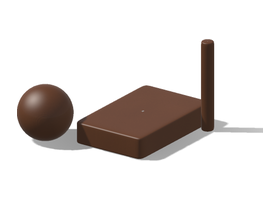 leather90/–/–
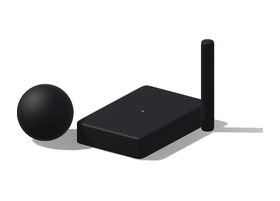 rubber1200/–/300
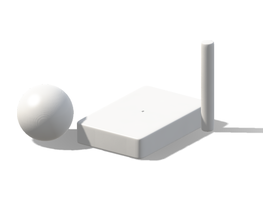 ceramic2300/–/400
 paper–/–/10
Physics
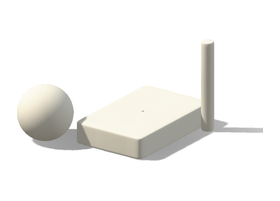
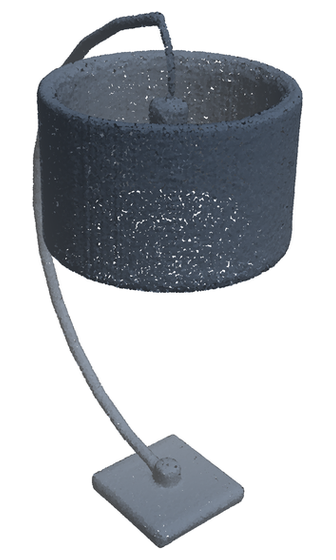
The predicted parts must remain connected and satisfy checks for their support type: standing stability, wall contact or suspended balance.
Green and red mark passing and failing examples. Wall contact is checked geometrically; the perturbed failure is shown with hinge motion for illustration.
Verify
Analyse identifies the object's structure and materials from images, and Propose generates a primitive decomposition. Verify assesses it using geometric and physical checks and a VLM review. Critique turns these outputs into feedback, which Propose uses to generate the next decomposition. The highest-scoring decomposition that passes the physical checks is selected. Blue marks VLM reasoning; orange marks verification with tools and VLM review.
4 images + camera views
drafting chair free-standing
round 0
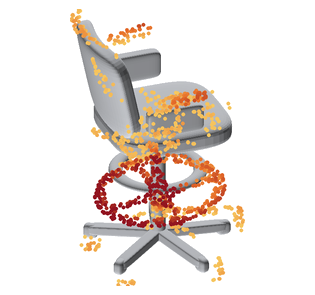
✗ 2 pieces
62 / 100
“Most important is the floating foot ring. The physics image shows it red, about 0.12 from anything, and it fell down the column.”
Repeat for up to 3 correction rounds
Evolve
Offline, PhysDec-Loop provides verified corrections on training objects to build a retrieval library and guide prompt evolution with GEPA. Candidate prompts are evaluated using the same verifiers. At test time, PhysDec-Evolved reuses Analyse and Propose with the evolved prompts and retrieved experience, predicting in two VLM calls without point-cloud feedback or an online correction loop. VLM weights remain fixed throughout.
Offline self-evolution Training objects with reference geometry
Keep corrections that improve the score.
Exemplars: verified decompositions
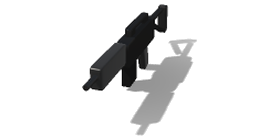
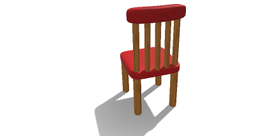
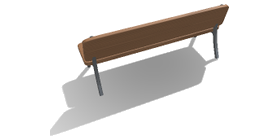
Insights: reusable advice from successful corrections
Material priors: by category and part
Keep prompts that improve validation performance.
Predict a new object Images only · Two VLM calls
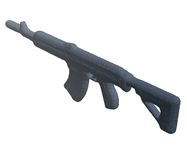
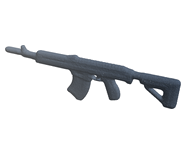
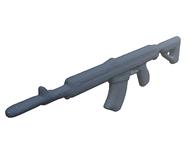
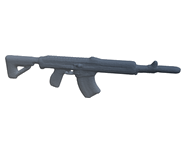
rifle handheld
+ 8 more
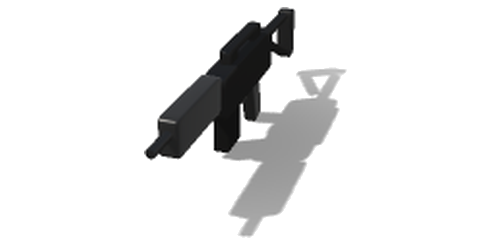
A similar exemplar, relevant insights and material priors.
No online verification or correction loop.
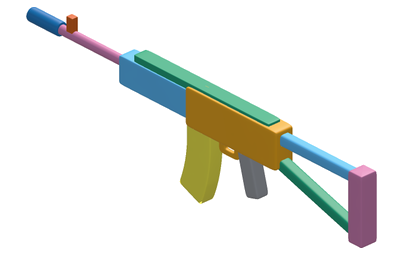
two model calls
03 / Evaluation
We compare PhysDec with SQ, EMS, Marching-Primitives, SuperDec and SuperFlex in geometric fidelity, physical plausibility and visual quality.
| Method | CD-L1 ↓ | #Prim. | Phys. pass (%) ↑ | VLM ↑ Sonnet 5.5 | VLM ↑ GPT-6.1 Sol |
|---|
585 test objects across 13 categories. PhysDec receives four images; baselines receive ground-truth point clouds. PhysDec-Loop also uses the reference point cloud for verifier feedback.
PhysDec-Loop achieves the lowest Chamfer distance and the highest physical-check pass rate and visual scores. Most baseline failures involve disconnected parts, despite plausible surface fits.
CD denotes Chamfer-L1 ×100; our predicted parts are fitted to reference points before CD evaluation, as described in the paper. Both VLM judges score the same renders. † Marching-Primitives receives a reference SDF.
Primitive decompositions from the baselines, PhysDec-Evolved and PhysDec-Loop.
Physical comparisons on a separate set of ShapeNet examples after 4 s of simulation.
For unstable simulations, playback may omit ejected parts or stop at the last valid frame.
| Calls | CD-L1 ↓ | #Prim. | Phys. pass (%) ↑ | VLM ↑ | |
|---|---|---|---|---|---|
| Base (original prompt) | 2 | 1.526 | 7.0 | 88.4 | 73.5 |
| PhysDec-Evolved | 2 | 1.528 | 8.2 | 99.0 | 75.8 |
| PhysDec-Loop (3 rounds) | 12.9 | 1.448 | 7.4 | 99.3 | 78.0 |
Self-evolution uses 20 training objects per category (260 total) and raises physical validity from 88.4% to 99.0%. PhysDec-Evolved approaches PhysDec-Loop’s physical and visual quality with 2 model calls per object, compared with 12.9 for PhysDec-Loop.
On 52 objects from 11 ASE scenes, PhysDec-Loop reconstructs complete objects from partial observations. It uses rendered views of the same partial point clouds supplied to the baselines and improves both geometric fidelity and physical validity.
| Method | CD-L1 ↓ | #Prim. | Phys. pass (%) ↑ | VLM ↑ |
|---|---|---|---|---|
| SuperDec | 4.18 | 5.5 | 11.5 | 35.7 |
| SuperFlex | 4.37 | 5.5 | 19.2 | 41.8 |
| SuperFlex (ASE-tuned) | 2.59 | 4.2 | 65.4 | 52.4 |
| PhysDec-Loop | 2.22 | 7.5 | 100.0 | 77.4 |
SuperFlex (ASE-tuned) is fine-tuned on partial ASE clouds.
PhysDec-Loop reconstructs each object from rendered views of its scanned points. A scene-level VLM infers support relations, and a physics solver adjusts object placements while preserving part geometry.
Input point clouds and reconstructions from four Replica scenes. Views are synchronized: drag to rotate, Ctrl/⌘ + scroll to zoom, and click an object to highlight it. Some scenes include manual adjustments.
| Variant | CD-L1 ↓ | #Prim. | Phys. pass (%) ↑ | VLM ↑ |
|---|---|---|---|---|
| PhysDec-Loop | 1.421 | 7.2 | 99.0 | 78.2 |
| Verifiers | ||||
| w/o physics | 1.415 | 7.4 | 93.3 | 79.0 |
| w/o VLM review | 1.417 | 7.1 | 97.9 | 75.1 |
| w/o point cloud | 1.479 | 7.4 | 98.5 | 80.0 |
| Input | ||||
| Single view | 1.601 | 7.0 | 97.9 | 72.9 |
| Model configuration | ||||
| GPT-6.1 Sol | 1.329 | 9.3 | 99.0 | 82.0 |
| Qwen3.8-Flash-Next | 1.670 | 7.0 | 98.5 | 69.5 |
Physical feedback improves physical plausibility, while VLM review improves visual quality. Point-cloud feedback mainly reduces Chamfer distance. Multiple input views improve geometric and visual quality. The lower-cost, open-source Qwen configuration also achieves a 98.5% physical-check pass rate.
195 ShapeNet objects, one run per variant without resampling. Ablated verifiers are removed from feedback, scoring and selection. Sonnet 5.5 grades every row; Qwen uses Qwen3.8-27B for review.
04 / Application
We test pick-and-place manipulation in reconstructed Replica scenes using a KUKA arm with an Allegro hand. All methods use the same grasp planner and matched object masses. PhysDec supports successful manipulation; baseline failures include disconnected parts, failed grasps and collisions.
Selected qualitative examples. Use the tabs to switch examples. When no grasp succeeds, the animation illustrates an attempted grasp.
These ShapeNet objects come from the object-level evaluation above. The robot lifts, carries and places each reconstruction; success requires moving all parts and leaving the object stable.
Selected examples where PhysDec passes the physical checks and both baselines fail; these are qualitative demonstrations.
@misc{physdec2027,
  title     = {Decompose, Verify, Evolve: Physically Grounded Shape Decomposition},
  author    = {Ma, Wenchao and Yu, Rui and Zhu, Fan and Liu, Jiachen and Huang, Sharon X.},
  note      = {Under review},
  year      = {2027},
  url       = {https://wenchao-m.github.io/PhysDec/}
}